Sister Other Paranoia Story Overview
A spoiler-light look at the premise, tone, and sibling-centered darkness ahead.
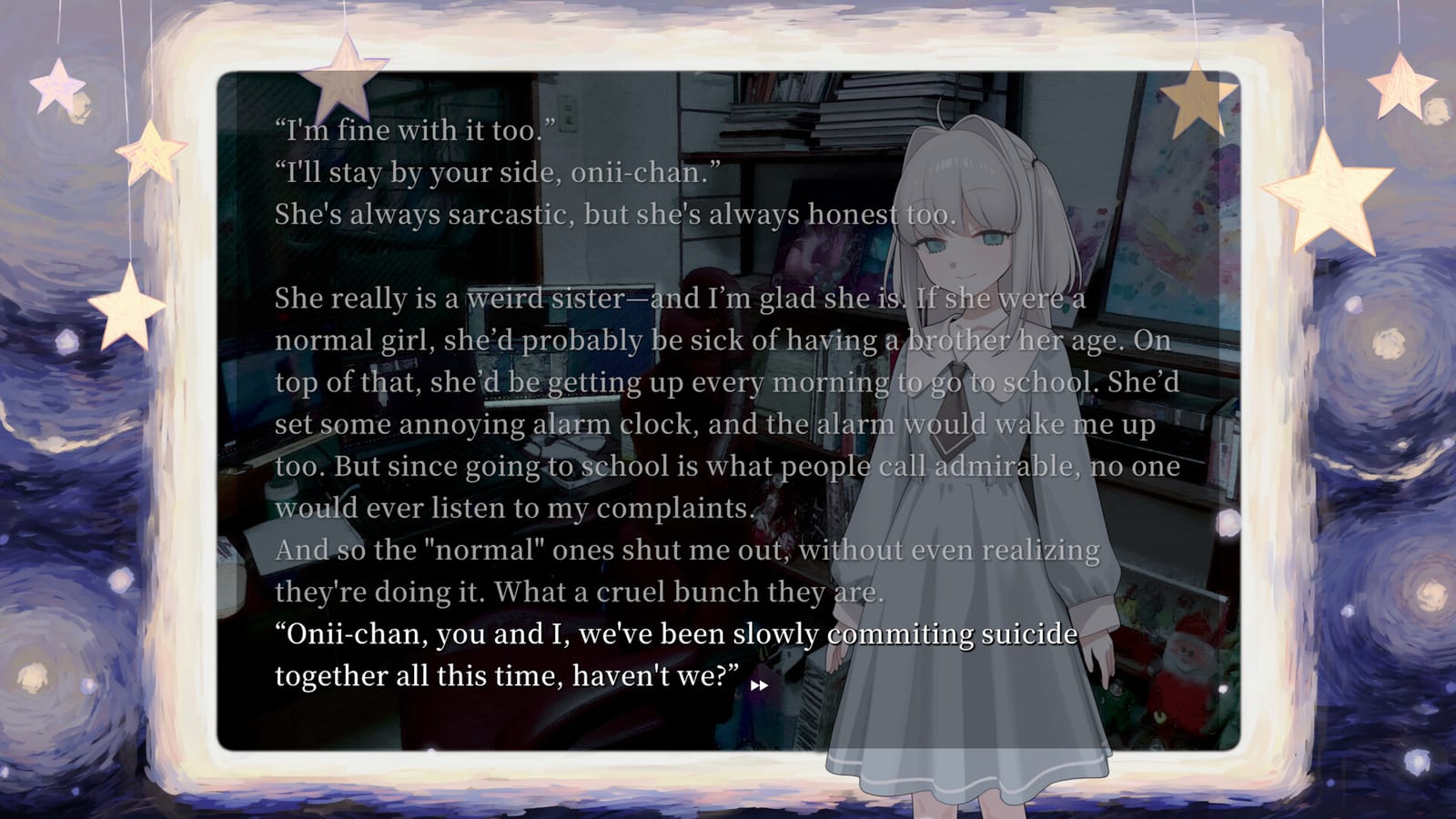
The official shape of the story
Sister Other Paranoia follows an overly sensitive protagonist—a light novel writer—who develops the ability to read minds. Official copy is blunt about the emotional outcome: instead of becoming socially fluent, he is driven deeper into isolation. Other people’s jealousy, envy, and careless cruelty become impossible to filter out. The one comfort that remains is his younger sister, described as gifted yet lonely. Together they cling hard enough that the relationship turns into a twisted, unhealthy codependency.
Serenity Forge’s public synopsis leans on a devastatingly simple line of branding: everyone else should die, except his sister. That slogan is tone, not a wiki license to invent body counts or ending slides. The game asks what happiness is and what future the siblings walk into, then tells the audience to witness the answer. This overview stops before that witness point.
A classic visual novel frame
HazeDenki presents Sister Other Paranoia as an old-school, straight-ahead visual novel. Text fills the screen. You read. You click. You can right-click to hide the text and spend time with the art. The fantasy loop is atmospheric rather than systemic: endure a gloomy, suffocating social world through an overly sensitive point of view, then return to the fraught warmth of sister-bound domestic space.
That structure matters for expectations. If you want complex crafting trees, this is the wrong pitch. If you want prose, CG emphasis, music, and moral nausea around mind-reading as a weapon, you are in the right aisle. More interaction detail belongs on Gameplay once you leave the Story cluster; more credits belong on staff.
Mind-reading as social horror
The mind-reading ability is not marketed as a cute dating perk. As friction with people around the protagonist piles up, the story allows moments where petty thoughts spark murderous rage. In those moments, mind-reading can be used to hit deep-seated insecurities and drive someone to suicide. The text even voices a chilling rationalization: you are not killing with your own hands, so you will not get caught—then immediately undercuts that comfort by asking whether it is really okay.
This wiki will describe that premise because the developer already did. We will not catalog scenes, victims, or “optimal corruption paths.” If that single paragraph is already a hard stop for you, read content warnings and consider walking away before purchase.
Sisterhood and codependency
The sibling relationship is the emotional engine. Official materials stress loneliness on both sides and a nightly slide into dependence that keeps them alive while twisting them. The protagonist’s public success as a light novel newcomer does not save him; award attention brings more poisonous thoughts from others and further damages the few relationships he has left. Home becomes both shelter and trap.
For character-focused reading without spoiler spreadsheets, continue to characters. For creative context—nyalra’s scenario and direction, Ohisashiburi’s art, Aiobahn +81’s music—see staff.
Themes you can name safely
Safe pre-release theme labels include:
- Social anxiety and hypersensitivity
- Isolation after unwanted visibility
- Unhealthy family intimacy and codependency
- Moral injury around harming others through psychological attack
- Questions about happiness when comfort is entangled with damage
Unsafe wiki behavior would include inventing therapy diagnoses for the cast, claiming a single “correct” moral reading, or pretending we know which ending is canon. Sister Other Paranoia is still approaching its Steam window—planned August 14, 2026 on the store, with press noting August 15, 3:00 AM UTC for Windows and macOS—so player consensus has not even formed yet. Use release date for timing and price for the about-$9.99 figure.
Mature content in narrative context
The developers’ mature content description flags blood and injury imagery including illustrated CGs appropriate for a 16+ style rating, mild sexual themes and suggestive imagery, and themes related to mental health, emotional distress, and psychological instability. It also states that content is fictional/narrative, and that the game does not contain explicit sexual acts or extreme realistic violence. That is disclosure, not a dare. Sensitive players should treat it as a gate.
How this overview connects to the rest of the wiki
- Story Hub — section home
- Characters — sibling-centered cast framing
- Content warnings — fuller warning language
- Staff — named creative team
- Release Hub — date, price, specs, wishlist
- Wishlist — Steam alerts for app 4240150
- Guides — practical first-run help when available
- Review — expectation framing without fake scores
- Tools — comfort checking against disclosed themes
What remains deliberately unknown here
We do not know—and will not invent—how many major endings exist, whether the sister’s future is singular or branching, how often mind-reading can be used, or whether the narrative ultimately condemns, complicates, or aestheticizes the protagonist’s violence. Official marketing keeps those answers inside the game. Your job as a pre-release reader is only to decide if the premise’s darkness is a destination you consent to visit.
If a free demo becomes available through the game Discord as community coverage has suggested, use that demo to test prose voice and UI comfort. A demo can teach tone; it still may not reveal the ending, and this overview will not pretend otherwise.
Frequently Asked Questions
Quick answers to the most common questions.
Is this overview spoiler-free?
It uses official premise and theme language only. It does not describe endings, routes, or late-game revelations.
What is the core relationship in Sister Other Paranoia?
An overly sensitive light novel writer and his younger sister trapped in unhealthy codependency while he grows more isolated through mind-reading.
Does the protagonist hurt people?
Official materials state mind-reading can be used to target insecurities and drive others to suicide. Details beyond that premise are left to the game.
Where do I go next?
Read content warnings if you are sensitive to the themes, or characters and staff if you want more non-spoiler context.